
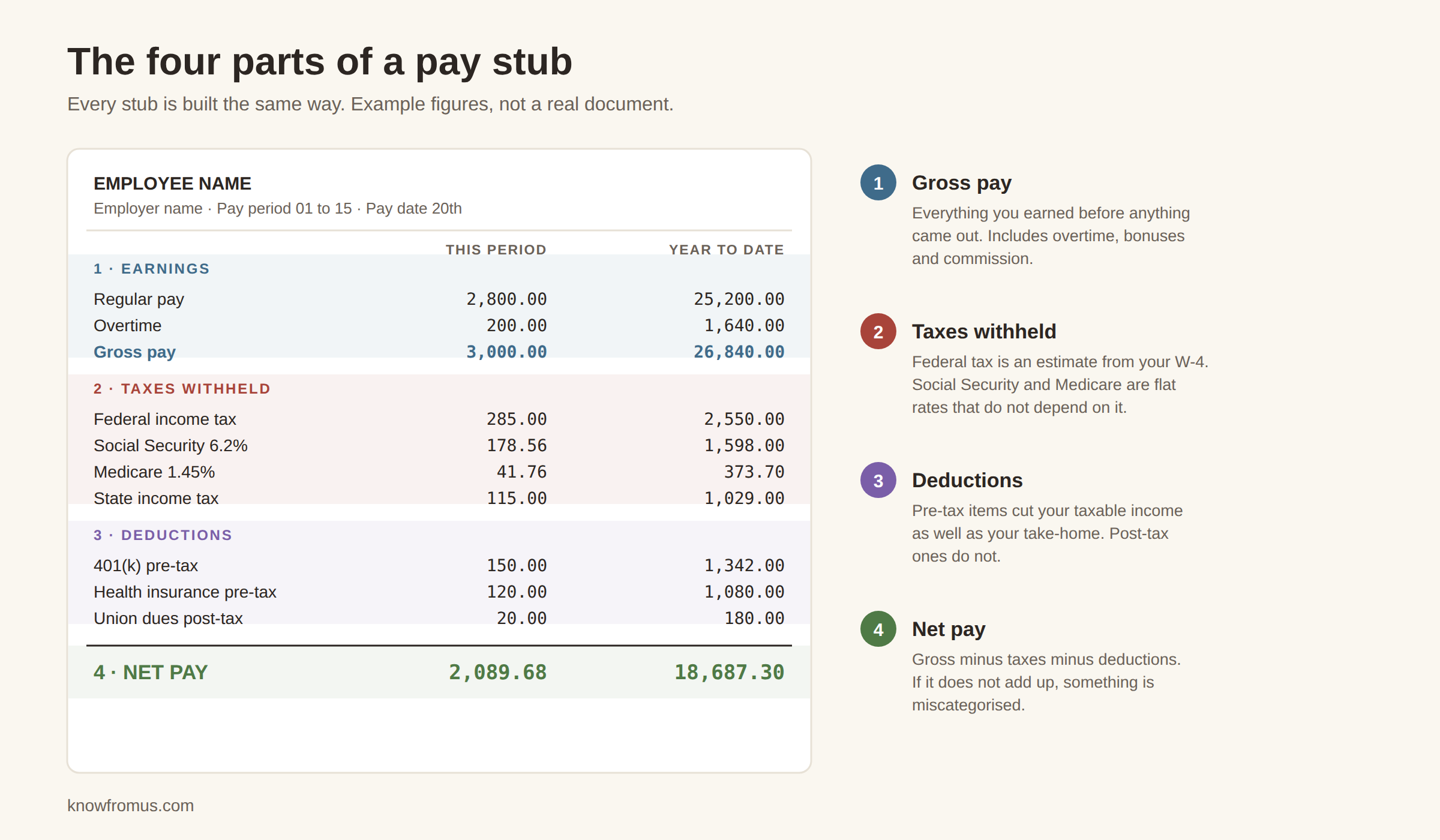
Most people glance at one number on a pay stub and file the rest. That is understandable, because the layout is dense and half the labels are abbreviations nobody explained. It is also how payroll errors go unnoticed for months, and how people end up surprised by their tax return.
Every pay stub, whatever the employer or the software, is built from the same four parts. Once you can see those four parts, any stub becomes readable.
The Four Parts of Any Pay Stub
- Gross pay, which is everything you earned before anything was taken out.
- Taxes withheld, which go to federal, state, and sometimes local government.
- Deductions, which go to insurance, retirement, and anything else you signed up for.
- Net pay, which is what actually arrives, and is gross minus the two categories above.
Alongside each of those you will usually see two columns: this pay period, and year to date. The year to date column is the one people ignore and the one most worth reading.
Gross Pay Is More Than Your Salary
The first part of any pay stub is gross pay, which is your base earnings plus anything else that counts as taxable compensation. On an hourly stub that means regular hours at your rate, overtime at the premium rate, and any shift differentials. On a salaried stub it is usually the annual figure divided by the number of pay periods.
Watch for items that are easy to miss. Bonuses, commission, and tips are part of gross pay. So are some things that never reach you as cash, such as the taxable value of group life insurance over a certain amount, or personal use of a company car. Those appear as income, get taxed, and are then backed out, which is why a stub can show earnings you never received.
If you are paid every two weeks, remember that two months a year have three pay dates rather than two. A monthly budget built on two paychecks a month will be wrong twice a year in your favour, which is a pleasant error but worth knowing about.
Federal Withholding Is Not Your Tax Rate
The federal income tax line is the one that confuses people most, because it is not a percentage of anything obvious. It is an estimate, worked out by your employer from the W-4 you filled in, of what you will owe across the whole year, divided across your pay periods.
That means two people on identical salaries can have very different federal withholding, because one claimed dependents and the other did not, or because one has a second job declared on their W-4. It also means the figure can be wrong. Withholding is a forecast, and if your circumstances changed and your W-4 did not, the forecast drifts.
A large refund every year is not a win. It means you lent the government money at no interest for twelve months. A large bill every year means the opposite and may bring a penalty. Either one is a signal to update your W-4 rather than something to accept as fixed.
FICA: Social Security and Medicare
These two are often grouped under a single FICA line, and unlike federal withholding they are flat percentages that do not depend on your W-4. The rates are published by the IRS and have been unchanged for decades.
- Social Security is 6.2% of your wages, and your employer pays another 6.2% that never appears on your stub. It applies only up to an annual wage cap, which changes each year, so high earners stop paying it partway through the year and see their take-home rise.
- Medicare is 1.45% of your wages with no cap at all, matched again by your employer. An additional 0.9% applies to wages above $200,000 in a year, and that extra portion is not matched.
Two things worth knowing. Medicare is not health insurance you are buying now, despite the name, and it is not the same as the health premium elsewhere on your stub. And if you are self-employed you pay both halves of both taxes, which is why contract rates need to be meaningfully higher than salary to come out level.
State and Local Lines
What appears on this part of your pay stub depends entirely on where you live and work. Some states have no income tax at all. Some have a single flat rate. Others have progressive brackets like the federal system.
Below the state line there may be more. Some cities levy their own income tax, some counties do, and a few states have school district or transit levies on top. If you live in one jurisdiction and work in another, you may see withholding for both, with a credit sorting it out at filing time.
You may also see small mandatory items such as state disability or paid family leave contributions. These are usually a fraction of a percent and are easy to mistake for an error.
Our paycheck calculators cover the individual states, including the ones with local taxes stacked on top.
Pre-Tax and Post-Tax Deductions Are Not the Same
This distinction is worth real money and most pay stubs do not label it clearly.
Pre-tax deductions come out of your pay before tax is calculated, so they reduce your taxable income as well as your take-home. Traditional 401(k) contributions, most health insurance premiums, health savings accounts, and flexible spending accounts usually work this way. A hundred dollars into a pre-tax deduction costs you noticeably less than a hundred dollars of take-home pay.
Post-tax deductions come out afterwards and do not reduce your tax. Roth 401(k) contributions, union dues in many cases, wage garnishments, and charitable giving through payroll typically sit here.
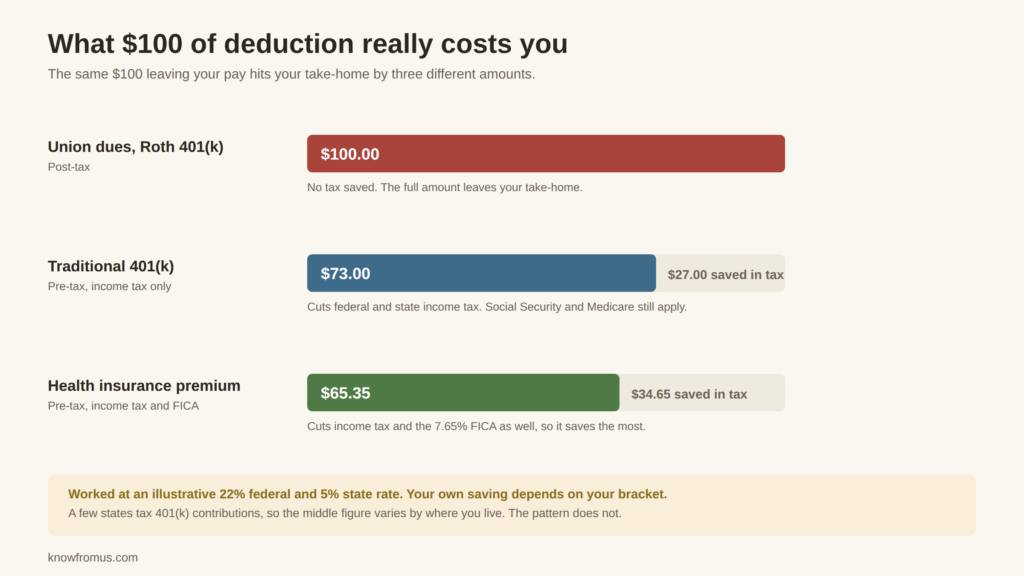
You can usually spot the difference without asking. If your taxable wages for the period are lower than your gross pay, the gap is your pre-tax deductions.
Read the Year to Date Column
The year to date column on your pay stub is where problems actually show up, because a single pay period rarely reveals anything.
Check whether your retirement contributions are on track to hit the annual limit, and whether they will hit it too early. Some employers only match on a per-period basis, so maxing out in October can cost you the match for the final two months of the year.
Check your year to date gross against what you expect to earn. If it is drifting, something is wrong with your rate or your hours. And check year to date federal withholding against what you think you will owe, because catching a shortfall in June is much easier to fix than discovering it in April.
What to Check on Every Stub
It takes about a minute once you know what you are looking at.
- Hours and pay rate are correct, including overtime at the right premium.
- Your deductions match what you actually signed up for, with nothing added you did not authorise.
- The state and any local tax lines match where you genuinely live and work.
- Gross minus taxes minus deductions equals net. If it does not, something is missing or miscategorised.
- Year to date figures move by roughly the right amount each period.
If something looks wrong, raise it with payroll in writing and keep the stub. Errors that run for months are far harder to unwind than ones caught in the same quarter, and in some cases an overpayment you did not notice can be clawed back later.
Keep your pay stubs, too. They are what lenders ask for on a mortgage application, what you need if you dispute a W-2, and the only record you have if an employer closes.
To see how the pieces fit together for your own situation, our paycheck calculator breaks a salary down into the same lines your stub uses.