
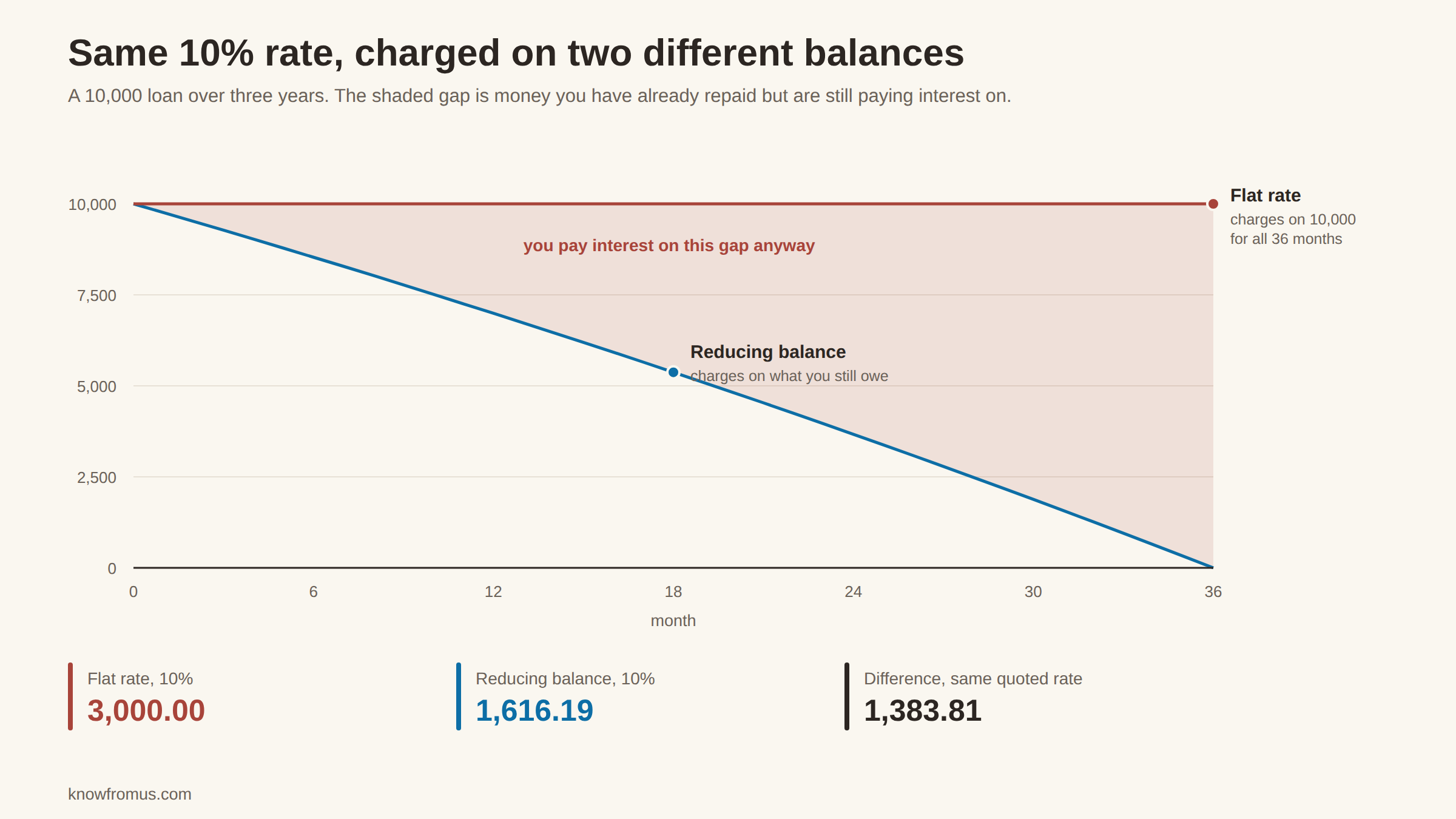
Two lenders quote you 10%. One of them will cost you nearly twice as much as the other, and nothing in the quote tells you which. The difference is not in the rate, it is in what the rate is charged on, and it is the single most expensive thing most borrowers do not know.
The Difference in One Sentence
A reducing balance rate charges interest on what you still owe. A flat rate charges interest on what you originally borrowed, for the whole term, no matter how much you have paid back. That is the entire difference between the two, and it is worth a lot of money.
That second part is what catches people. Under a flat rate, you are still paying interest in the final month on money you repaid two years earlier.
What It Looks Like in Numbers
Take a loan of 10,000 over three years at a quoted 10%.
Under a flat rate loan the arithmetic is simple, which is part of the appeal. Interest is 10,000 multiplied by 10% multiplied by three years, which is 3,000. You repay 13,000 in total, or 361.11 a month for 36 months.
Now work out what that monthly payment actually represents on a reducing balance basis, which is how a mortgage or a credit card is quoted. The answer is just under 18% a year. That is the true cost of the loan, and it is almost double the number on the advertisement.
The gap widens with the length of the loan, because the longer the term, the more of your balance you have already repaid while still being charged on the original sum.
- 8% flat over five years is roughly 14% on a reducing balance
- 10% flat over three years is roughly 18%
- 10% flat over five years is roughly 17%
- 12% flat over two years is roughly 22%
A reasonable rule of thumb is that a flat rate is worth roughly twice its stated number once converted, though the exact multiple depends on the term. Never compare a flat rate to a reducing one directly. They are different units.
Why Flat Rates Exist at All
A flat rate is not a trick in itself, and it is not illegal. They predate computers, and in a world of paper ledgers a flat rate was genuinely easier to administer because every payment was identical and the total was known on day one.
They survive now mainly in vehicle finance, consumer durables bought on instalments, some personal loans, and a great deal of lending in markets where disclosure rules are lighter. Where they become a problem is when a flat rate is quoted next to a reducing rate as though the two numbers mean the same thing.
How to Tell Which One You Are Being Offered
Lenders do not always volunteer it, but there are reliable signs.
- Ask directly whether the rate is flat or reducing balance. A straight question usually gets a straight answer, and hesitation tells you something on its own.
- Ask for the APR or effective rate. Where disclosure is required, this is the reducing balance figure and it is the only number worth comparing between offers. The Consumer Financial Protection Bureau makes the same point, and warns specifically against comparing an APR against a plain interest rate.
- Check whether the total interest is a neat round product. If a three year loan on 10,000 shows exactly 3,000 of interest, that is a flat rate, because reducing balance interest almost never lands on a round number.
- Look at what early repayment does. Under a flat rate, paying off early often saves you nothing at all, because the interest was fixed at the start. That is the clearest tell there is.
Two Offers, Side by Side
Imagine you need 10,000 over three years and you have two quotes in front of you.
Lender A offers 10% flat. Lender B offers 15% reducing balance. On the face of it A is cheaper by five points, and most people would stop reading there.
Lender A costs you 3,000 in interest, with payments of 361.11 a month. Lender B, charging 15% on a falling balance, costs about 2,480 in interest, with payments of around 346.65. The offer that looked five points more expensive is in fact the cheaper one by roughly 520 over the life of the loan.
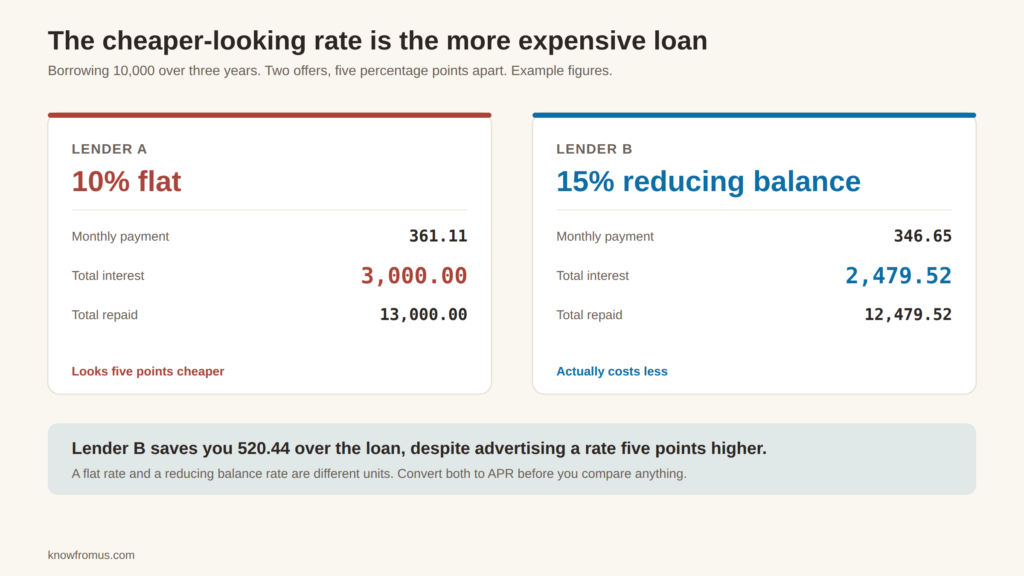
This is not an edge case constructed to make a point. It is the ordinary result of comparing two numbers that are not measured the same way, and it happens to borrowers constantly.
The Early Repayment Trap
This deserves its own section because it is where flat rate loans cost people the most, and where the surprise tends to arrive.
On a reducing balance loan, every extra payment you make reduces the balance that future interest is calculated on. Overpay by a few hundred and you save interest for the rest of the term. That is why mortgage overpayment is such effective use of spare money.
On a flat rate loan the interest was calculated once, at the start, on the full amount. Settling two years into a three year term does not undo that calculation. Depending on the contract you may get a partial rebate, you may get nothing, and some agreements add a settlement fee on top.
So if there is any chance you will clear the loan early, from a bonus, a sale, or simply a better month than expected, that possibility is worth real money on a reducing balance loan and close to nothing on a flat one. Ask what early settlement actually costs, and get the answer before you sign rather than after.
What This Means If You Are Borrowing
Compare like with like. Convert every flat rate offer to a reducing balance equivalent, or insist on the APR, before you decide anything. An offer that looks two points cheaper can easily be the more expensive one.
Ask specifically about early settlement before you sign, not after. If you expect to repay ahead of schedule, a flat rate loan removes most of the benefit of doing so, and that can matter more than the headline rate.
And treat a shorter term differently under each system. On a reducing balance loan, a shorter term saves interest. On a flat rate loan it saves proportionally less, because the interest was never tied to your balance in the first place.
None of this is advice about whether to take a particular loan, and we are not financial advisers. It is simply what the two numbers mean, so that you can compare offers on the same footing.
Our flat vs reducing rate calculator converts between the two for your own figures, and the EMI calculator shows the monthly payment and total interest on a reducing balance loan.