
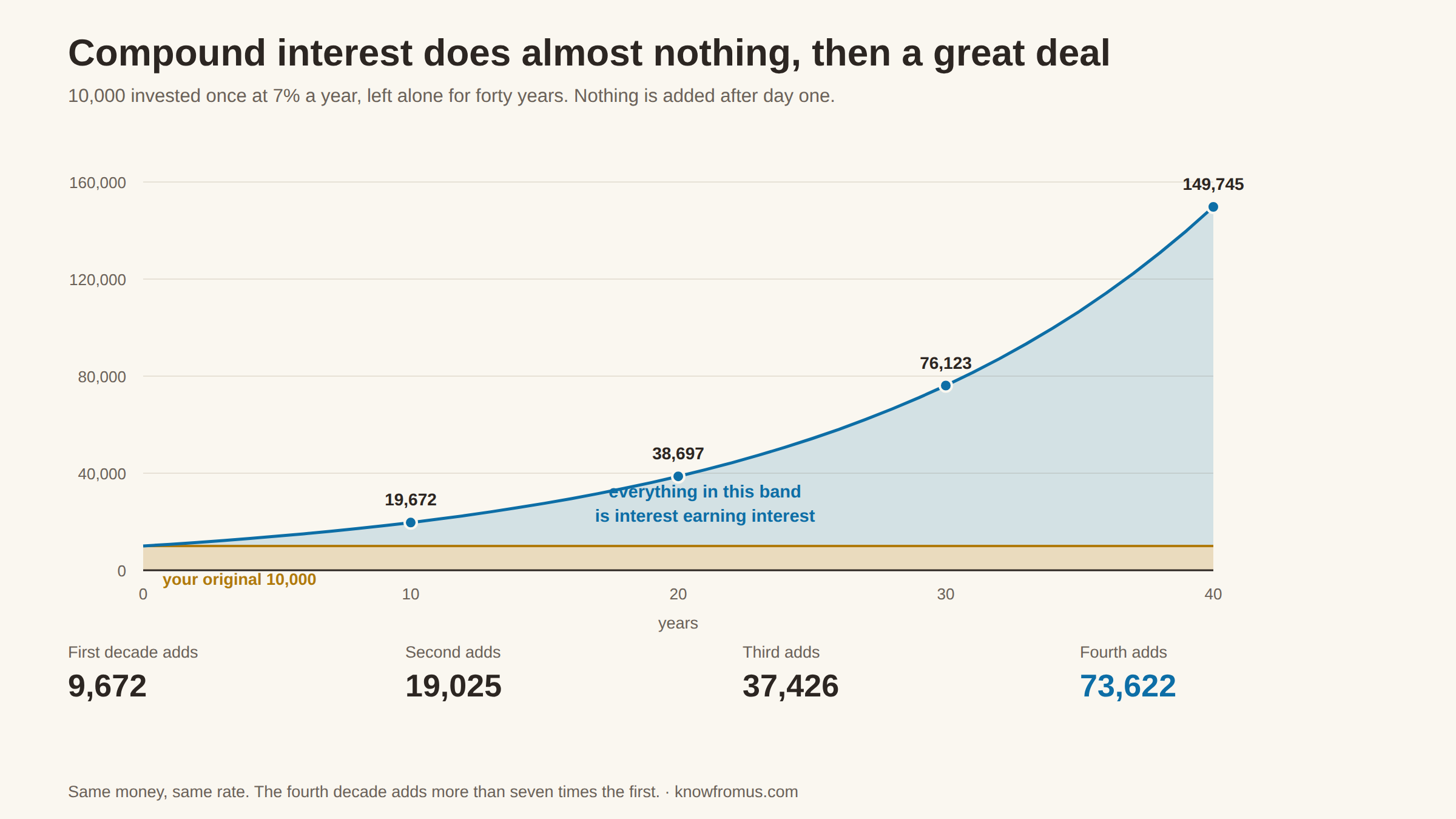
Compound interest gets described as money earning money, which is true but does not convey why it matters. What matters is that the effect is not gradual. It is almost nothing for a long time, and then it is enormous, and most people give up during the part where it looks like nothing is happening.
Simple Interest Against Compound Interest
Simple interest pays you on what you originally put in. Put 10,000 somewhere paying 7% simple and you collect 700 a year, every year, for as long as you leave it. After thirty years you have your 10,000 plus 21,000 of interest.
Compound interest pays you on what you put in plus everything it has already earned. Same 10,000 at the same 7%, left alone and compounded annually, is worth about 76,000 after thirty years.
Same money, same rate, same period. The difference is 45,000, and all of it comes from interest earning interest on itself.
The Curve Is the Whole Point
Here is what compound interest does to 10,000 at 7%, left untouched, at ten year intervals:
- After 10 years: about 19,700
- After 20 years: about 38,700
- After 30 years: about 76,100
- After 40 years: about 149,700
Look at what each decade adds. The first adds roughly 9,700. The fourth adds roughly 73,600. The money did nothing differently in the fourth decade, it was simply working on a much larger base.
This is why the single most valuable input is time, and why it cannot be bought back later. Someone who starts at 25 is not ten years ahead of someone who starts at 35. They are ahead by the largest decade, the one at the end.
The Comparison That Makes the Point
The clearest way to see compound interest at work is to compare two people, both earning 7% a year.
The first saves 500 a month from age 25 to 35, so for ten years, then stops completely and never adds another penny. She has contributed 60,000.
The second saves nothing until 35, then saves 500 a month every month until he is 65. He has contributed 180,000, three times as much, over three times as long.
At 65 the first has about 702,000. The second has about 610,000.
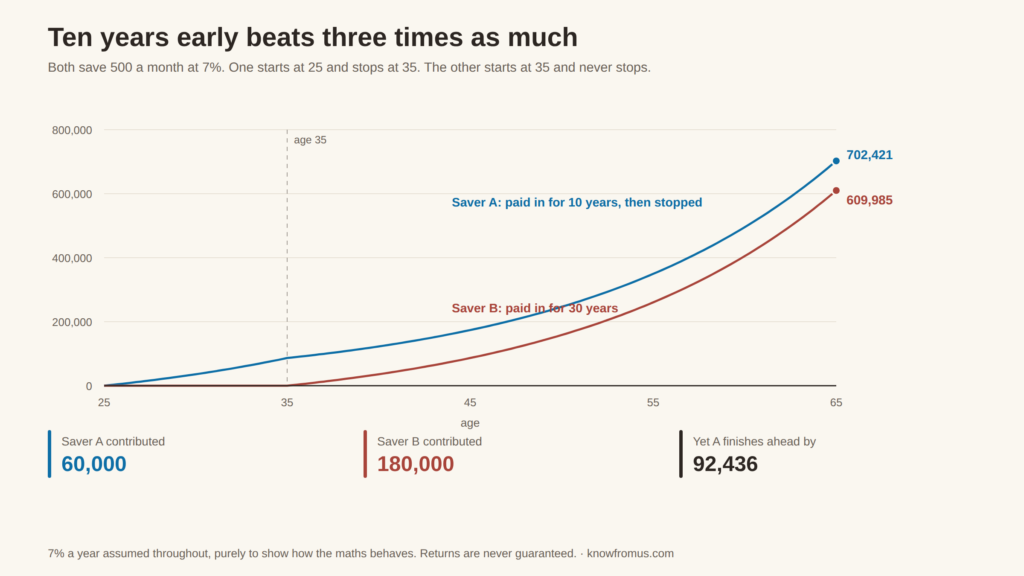
She put in 120,000 less and finished 92,000 ahead, purely because her money had a ten year head start before his began. That gap is not recoverable by saving harder later. It can only be closed by starting earlier, which is the one thing nobody can do retrospectively.
The Rule of 72
A piece of mental arithmetic worth keeping. Divide 72 by your annual rate and you get, near enough, the number of years for money to double. If you want the exact figure rather than the shortcut, the SEC runs a free compound interest calculator on Investor.gov.
At 7%, money doubles about every ten years. At 10% it is about seven years. At 3% it is twenty-four. It is not exact, but it is close enough to do in your head, and it turns an abstract percentage into something you can picture.
It also works in the other direction. At 3% inflation, prices double roughly every twenty-four years, which is why money left in a current account is not standing still. It is losing ground quietly.
Compounding Frequency Matters Less Than You Think
Compound interest can be calculated annually, quarterly, monthly, or daily, and more frequent compounding does produce a slightly better result, because you start earning on your earnings sooner.
But the effect is small. On 10,000 at 7% for a year, annual compounding gives 700 and daily gives about 725. Worth having, not worth choosing a worse product for.
When a bank advertises both a nominal rate and an effective annual rate, the effective rate is the one that already includes compounding frequency. Compare effective rates and you are comparing like with like.
What Quietly Works Against You
Compound interest is indifferent to whether it is helping or hurting you, and three things turn it against you.
Fees are the big one, and they are badly underestimated because they sound trivial. Take 100,000 growing at 7% for thirty years: it becomes about 761,000. The same amount growing at 6%, because a 1% annual fee was taken off the top, becomes about 574,000. That one percentage point cost 187,000, which is nearly twice the original investment.
Inflation compounds too, against your purchasing power rather than your balance. A return of 5% when inflation is 3% is a real return of roughly 2%, and it is the real figure that determines what your money will actually buy.
And debt compounds in exactly the same way, just pointed at you. A credit card at 20% that you only service with minimum payments is the same mathematics running in reverse, which is why high interest debt usually outweighs the case for investing until it is cleared.
What to Take From This
Start earlier rather than larger. A modest amount begun now beats a serious amount begun in five years, and the gap between those two options grows every year you wait.
Leave it alone. Compound interest only works on money that stays invested, and the long flat stretch at the beginning is the part that tempts people to withdraw.
And watch the percentage being taken off your return as closely as the percentage being added to it, because over decades they are the same lever.
Nothing here is investment advice and we are not financial advisers. Returns are never guaranteed and 7% is used throughout purely as a round number to show how the mathematics behaves.
To run these numbers on your own figures, use our compound interest calculator, or the SIP calculator if you are contributing monthly rather than investing a lump sum.