
FICA Tax Calculator
Social Security and Medicare withheld from your pay, including the pre-tax deductions that reduce them and the ones that do not.
FICA is the pair of deductions that almost nobody chooses and almost everybody misunderstands. It is not federal income tax, it does not go up or down with your W-4, and it is the one line on your stub that a pay raise cannot shelter you from. Use the FICA tax calculator above to see what you are paying, then read on, because there is one thing about it that can save you several hundred dollars a year and most people have never heard of it.
What FICA Actually Is
FICA stands for the Federal Insurance Contributions Act, and it is two taxes traveling under one name.
Social Security takes 6.2 percent of your wages, up to an annual ceiling. Once your wages for the year pass that ceiling, Social Security stops being withheld until January.
Medicare takes 1.45 percent of your wages with no ceiling of any kind, plus an extra 0.9 percent on wages above a threshold.
Those rates are set in federal law and they have been stable for decades. The 6.2 percent has been in place since 1990 and the 1.45 percent since 1986. Whatever else moves in the tax code, these two numbers mostly do not, which is unusual and worth knowing when you are planning.
The one figure that does move is the Social Security wage ceiling, which the Social Security Administration adjusts each year in line with national average wages. For 2026 it is $184,500. Check the IRS page on withholding rates for the current figure rather than trusting any site’s table, including this one.
Social Security Stops. Medicare Never Does.
This is the behavior that confuses people most, usually in the fall when a high earner notices their take-home pay has suddenly jumped.
Nothing has changed about your salary. You have simply hit the Social Security wage ceiling for the year, so 6.2 percent of your pay stopped going out of the door. At the 2026 ceiling of $184,500, the most Social Security anyone pays as an employee is $11,439 a year. Earn half a million and you still pay $11,439. Earn five million and you still pay $11,439.
Medicare behaves in the opposite way. There is no ceiling, so 1.45 percent keeps coming out of every dollar for as long as you keep earning, and above the surtax threshold it becomes 2.35 percent.
The practical consequence is that FICA is regressive at the top and flat in the middle. Someone on $60,000 pays 7.65 percent of everything they earn. Someone on $600,000 pays around 3 percent of theirs. That is a design feature rather than a loophole, because Social Security benefits are also capped, but it surprises people who assume payroll tax works like income tax.
The 0.9 Percent Surtax Thresholds Have Never Moved
The Additional Medicare Tax is 0.9 percent on wages above $200,000 if you file single or head of household, $250,000 if you file jointly, and $125,000 if you are married filing separately.
Here is the part worth knowing. Those thresholds were written into law in 2013 and they are not indexed to inflation. Unlike tax brackets, the standard deduction or the Social Security wage ceiling, which all climb every year, these numbers have sat completely still since the day they were enacted. A salary that was comfortably below $200,000 a decade ago may be above it now purely because of inflation, and the threshold did not move to meet it.
So this is a tax that quietly catches more people every year without anyone voting on it. If you are anywhere near those figures, expect to stay caught.
Which Pre-Tax Deductions Cut FICA, and Which Do Not
This is the section worth real money, and it is the thing almost every other FICA tax calculator leaves out entirely.
People use “pre-tax” as though it means one thing. It does not. Some deductions come out before income tax only. Others come out before income tax and before FICA. The difference is worth 7.65 percent of whatever you put through them.
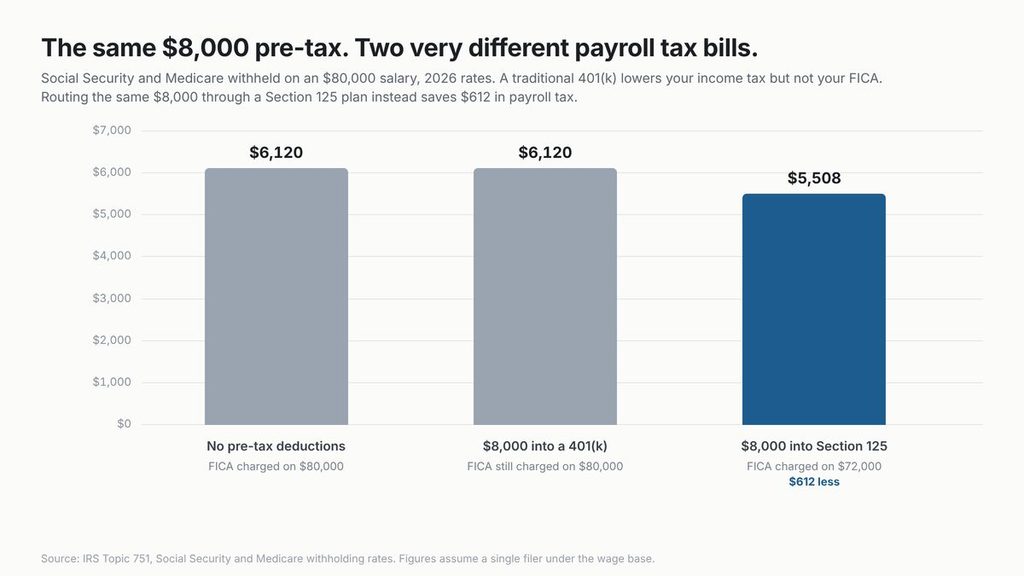
A traditional 401(k) does not reduce your FICA. It lowers the wages your federal income tax is calculated on, but Social Security and Medicare are still charged on your full gross. Put $8,000 into a 401(k) and your FICA bill is identical to what it would have been if you had put in nothing.
Section 125 benefits do reduce your FICA. Health, dental and vision premiums taken through a properly documented Section 125 cafeteria plan come out before FICA is worked out, as do health FSA contributions, dependent care FSA contributions and HSA contributions made through payroll.
| Deduction | Cuts income tax | Cuts FICA |
|---|---|---|
| Traditional 401(k) or 403(b) | Yes | No |
| Roth 401(k) | No | No |
| Health, dental and vision premiums through a Section 125 plan | Yes | Yes |
| Health FSA | Yes | Yes |
| Dependent care FSA | Yes | Yes |
| HSA contributions made through payroll | Yes | Yes |
| Health premiums deducted after tax | No | No |
On an $80,000 salary the arithmetic is stark. With no pre-tax deductions you pay $6,120 in FICA. Put $8,000 into a traditional 401(k) and you still pay $6,120. Put the same $8,000 through a Section 125 plan and you pay $5,508. The $612 difference is Social Security and Medicare you simply never owed.
Two cautions. The Section 125 exemption only applies if your employer has set up a formal written plan, which is not automatic. If your health premiums are deducted after tax, you get no FICA benefit at all. And a Roth 401(k) reduces neither, because it is funded with money that has already been taxed both ways.
None of this is an argument against a 401(k). The point is narrower: if you have a choice about which pre-tax bucket something goes into, the FICA treatment is part of the comparison, and our 401k calculator covers the retirement side of that decision.
Your Employer Pays the Same Again
For every dollar of FICA that leaves your paycheck, your employer sends a matching dollar of its own. Social Security is 6.2 percent from you and 6.2 percent from them, so 12.4 percent in total. Medicare is 1.45 percent from each, so 2.9 percent. Together that is 15.3 percent of your wages going to the two programs, of which you see half.
The one exception is the 0.9 percent surtax. Your employer withholds it from you but pays nothing itself. It is the only part of FICA with no match.
Most economists argue the employer half is effectively paid by you anyway, in the form of a lower salary than you would otherwise be offered. Whether or not you find that convincing, it is useful context when you are comparing an employee offer against contract work, because a contractor sees the whole 15.3 percent arrive as a bill.
Married Couples Get the Surprise
Your employer is required to start withholding the 0.9 percent surtax once your wages pass $200,000, and it does this without regard to your filing status, because it has no way of knowing what your spouse earns.
That produces errors in both directions. A married couple filing jointly where one person earns $230,000 will have the surtax withheld on $30,000 of wages, around $270, even though their joint threshold is $250,000 and they may owe none of it. They get it back when they file.
The reverse is more painful. Two spouses each earning $160,000 have a combined $320,000, which is $70,000 over the joint threshold, so they owe $630. Neither employer withholds a cent of it, because neither salary passes $200,000 on its own. The bill arrives at filing time with no warning.
If you are a dual income household anywhere near those figures, this is worth checking in advance rather than discovering in April.
If You Are Self-Employed, You Pay Both Halves
There is no employer behind you to pay the matching share, so you pay it yourself. That is self-employment tax, and it is the same 15.3 percent, just arriving in one piece rather than two.
Two things soften it. You only pay on your net profit rather than your gross receipts, and you can deduct half of what you pay when working out your income tax. It still catches out people in their first year of freelancing, who budget for income tax and forget this entirely. Our self-employment tax calculator works out the figure, and the quarterly tax calculator handles the payment schedule.
Why a FICA Tax Calculator Can Only Estimate
A FICA tax calculator is more predictable than an income tax one, because the rates are flat and your W-4 has no effect on them at all. But a few things still move the number.
If you changed jobs mid-year, each employer tracks the Social Security ceiling separately, so between them they may over-withhold. You claim the excess back on your return rather than losing it. Bonuses, commission and most taxable fringe benefits all count as wages for FICA. Reimbursed business expenses under an accountable plan do not.
And a handful of situations sit outside FICA entirely, including some student employment at the school you attend and certain household and family employment arrangements. Those are narrow, but if you think one applies to you it is worth confirming rather than assuming.
A FICA tax calculator deals with the federal half only. To see it in the context of a whole paycheck with state tax included, try the paycheck calculators for your state.
What FICA Actually Buys You
It is easy to read a FICA tax calculator as a record of money disappearing. It is worth remembering what it is buying.
Social Security is not only a retirement pension. It also pays disability benefits if you can no longer work, and survivor benefits to your spouse and children if you die. For a young worker with a family, that survivor coverage is worth a substantial amount of term life insurance that you are not separately paying for. Medicare funds hospital insurance from age 65.
Both are earned through work credits, which is why the deduction follows your wages rather than your tax return. Your benefit later is calculated from your highest earning years, so the years you pay the most are generally the years that raise your eventual payment the most.
Frequently Asked Questions
Is FICA the same as federal income tax?
No. They are separate lines with separate rules. Federal income tax varies with your W-4, your filing status and your deductions. FICA is a flat percentage of wages that your W-4 does not affect at all.
Why did my take-home pay suddenly go up late in the year?
You most likely hit the Social Security wage ceiling, so 6.2 percent stopped being withheld for the rest of the year. It restarts in January.
Does contributing more to my 401(k) lower my FICA?
No. A traditional 401(k) lowers the wages your income tax is based on, but Social Security and Medicare are still charged on your full gross pay. Section 125 health benefits are the ones that reduce FICA.
Can I get a refund of FICA I overpaid?
If you had more than one employer in a year and together they withheld Social Security on more than the wage ceiling, yes, you claim the excess on your tax return. A single employer that over-withheld should correct it directly.
Why is there no FICA on my pension or investment income?
FICA applies to earned income from work. Pensions, dividends, interest, capital gains and rental income are not wages, so no Social Security or Medicare is taken from them.
My spouse and I both earn under $200,000. Do we owe the 0.9 percent surtax?
Possibly. The joint threshold is $250,000 on combined wages, so two salaries of $160,000 each put you over it even though neither employer withholds anything. The bill lands at filing.
Do employers pay the 0.9 percent surtax too?
No. It is the one part of FICA with no employer match. They withhold it from you and contribute nothing themselves.
Why does this FICA tax calculator differ from my pay stub?
Usually a pre-tax benefit the calculator does not know about, a mid-year job change that reset the Social Security ceiling, or taxable fringe benefits counted as wages that are not in your salary figure. The rates themselves are fixed, so a large gap is almost always a difference in the wage base rather than the math.