
Bonus Tax Calculator
What your employer withholds from a bonus, and why it is more than your normal paycheck rate.
You were told the bonus was $10,000. The deposit was $6,012. Nothing has gone wrong, nobody has made a mistake, and you have not been taxed at 40 percent. Use the bonus tax calculator above to see where the money went, then read on for the part that matters: most people get a chunk of it back.
Why Your Bonus Looks Savaged
A bonus is what the IRS calls a supplemental wage, and supplemental wages have their own withholding rule. Instead of running your bonus through your W-4 the way your salary goes, your employer can withhold a flat 22 percent for federal income tax and be done with it.
That is already higher than most people’s actual federal rate on their salary. Then your state takes its own supplemental cut, which in California is 10.23 percent on a bonus. Then Social Security takes 6.2 percent and Medicare 1.45 percent, exactly as they do on everything else.
Add those together for a Californian and you are at 39.88 percent withheld before anyone has looked at your personal circumstances at all. The money is not gone. It has been handed to the government early, on an assumption about your tax rate that is probably wrong.
The Two Methods Your Employer Can Use
Which one you get is your employer’s choice, not yours, and it changes the number meaningfully.
The percentage method is the flat 22 percent. Your employer runs the bonus as a separate payment, withholds the flat rate and moves on. It is simple, it is what most larger employers use, and it is what the calculator above models.
The aggregate method means your bonus is bundled into your normal paycheck and the whole lump is run through your W-4 as though you earn that much every pay period. Payroll software sees a sudden enormous paycheck, assumes you are now in a far higher bracket, and withholds accordingly. On a large bonus relative to your salary, this method withholds considerably more than 22 percent.
If your bonus arrived on the same stub as your salary, with one combined gross figure, you got the aggregate method. If it arrived as a separate payment, you almost certainly got the flat rate.
Neither method changes what you eventually owe. They only change how much is held back in the meantime.
Your State Takes a Very Different Cut
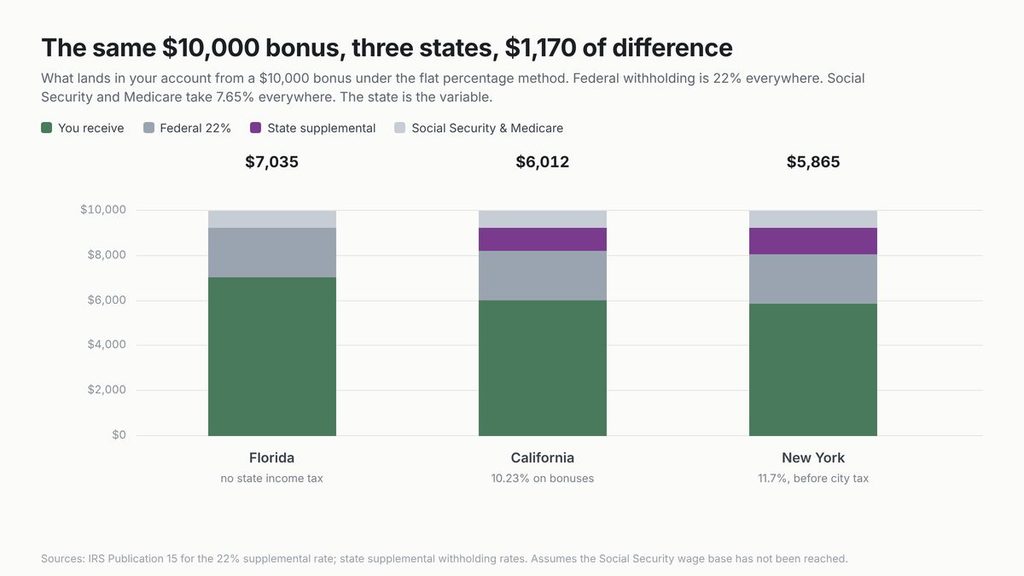
Many states set a separate supplemental rate for bonuses, and the spread between them is wide. Here is the same $10,000 bonus in three states:
| State | State supplemental rate | Total withheld | You receive |
|---|---|---|---|
| Florida | None | $2,965 | $7,035 |
| California | 10.23% | $3,988 | $6,012 |
| New York | 11.7% | $4,135 | $5,865 |
That is $1,170 of difference on the same bonus, purely from where you live. And the New York figure is before any city tax, so a New York City resident keeps less again.
California is worth a note of its own. It charges 10.23 percent on bonuses and stock but only 6.6 percent on other supplemental pay, so the state singles bonuses out specifically.
Some states with income tax have no separate supplemental rate at all and simply apply their normal flat rate, which is how Illinois at 4.95 percent and Colorado at 4.4 percent work. Nine states take nothing because they have no wage income tax: Alaska, Florida, Nevada, New Hampshire, South Dakota, Tennessee, Texas, Washington and Wyoming.
For the full picture of how each of these states treats your regular pay, see our California paycheck calculator, New York paycheck calculator and Florida paycheck calculator.
A $10,000 Bonus, Line by Line
Worth walking one all the way through, because the stub rarely labels any of this clearly. Take a Californian earning a normal salary who receives a $10,000 bonus in March, paid as a separate payment.
| Line | Rate | Amount |
|---|---|---|
| Bonus | $10,000.00 | |
| Federal supplemental withholding | 22% | -$2,200.00 |
| California supplemental withholding | 10.23% | -$1,023.00 |
| Social Security | 6.2% | -$620.00 |
| Medicare | 1.45% | -$145.00 |
| Deposited | 60.12% | $6,012.00 |
Of the $3,988 withheld, only $765 is genuinely gone. That is the Social Security and Medicare, which are final and never refunded. The other $3,223 is income tax withholding, which is a prepayment against a bill that has not been calculated yet.
If this person’s actual combined federal and state rate on that money turns out to be 25 percent rather than the 32.23 percent withheld, roughly $723 comes back at filing. If they are a higher earner already, they may owe more instead. The bonus tax calculator above cannot know which, because it does not know the rest of their year.
Pay the same bonus in December, after the Social Security wage base has been crossed, and the deposit becomes $6,632 instead. Identical bonus, $620 difference, purely from the month it landed.
Withholding Is Not Tax
This is the single most important thing on the page, and it is the reason most people calm down once they understand it.
There is no special bonus tax rate. Your bonus is ordinary income. At the end of the year it is added to everything else you earned and taxed at your actual marginal rates, exactly like salary. The 22 percent is a prepayment made by someone who has no idea what your total income, deductions or credits will look like.
So if your real federal rate on that money turns out to be 12 percent, the extra 10 percent comes back as part of your refund. If your real rate is 32 percent, the 22 percent was not enough and you will owe the difference. Which way it goes depends entirely on your total income, not on the bonus.
People on modest salaries who receive a large one-off bonus are usually over-withheld and get money back. People who are already high earners are often under-withheld and owe. If you want to see which bracket the bonus actually pushes you into, our tax bracket calculator works through marginal against effective rates.
FICA Applies Too, With One Exception
Social Security and Medicare come off a bonus just as they come off salary, at 6.2 percent and 1.45 percent. Unlike income tax withholding, these are not prepayments of anything. They are final, and no part of them comes back at filing.
The exception is the Social Security wage base. Social Security only applies to wages up to an annual ceiling, which for 2026 is $184,500. If you have already passed that for the year, the Social Security line on your bonus is zero, and your effective withholding rate drops noticeably.
This is why a December bonus can look very different from the same bonus paid in March. On a $10,000 bonus in California, having already crossed the wage base takes the effective rate from 39.88 percent down to 33.68 percent, worth $620 in your pocket. Our FICA tax calculator explains how that ceiling works.
Medicare has no ceiling and keeps applying at 1.45 percent, with an extra 0.9 percent once your wages for the year pass $200,000 single or $250,000 joint.
Bonuses Over a Million Dollars
If your supplemental wages for the calendar year exceed $1 million, the rate on the excess jumps to 37 percent, and at that point the flat rate is mandatory rather than optional.
It works as a two-tier calculation rather than a cliff. A $1.5 million bonus is withheld at 22 percent on the first million and 37 percent on the remaining $500,000. Both rates were made permanent by legislation in 2025, so they are not scheduled to expire the way the previous rules were.
What You Can Actually Do About It
Not much on the withholding itself, which is set by rule rather than preference. But a few things genuinely help.
Divert part of it into your 401(k). Many employers let you set a separate deferral percentage for bonuses. Money going into a traditional 401(k) comes out before federal and state income tax is calculated, so it reduces the withholding directly. It does not reduce Social Security or Medicare, which are taken on gross. Our 401k calculator shows the effect.
Check the timing if you have any say. A bonus paid after you have crossed the Social Security wage base costs you 6.2 percent less in withholding. Few people get to choose, but it is worth asking if the payment date is flexible.
Adjust your W-4 if you are consistently over-withheld. If a large bonus every year reliably produces a large refund, you are lending money interest free for twelve months. A W-4 adjustment spreads that back across your paychecks.
Do not spend it before it lands. Budget on roughly 60 to 70 percent of the headline figure depending on your state, and treat anything above that as a pleasant surprise.
Why a Bonus Tax Calculator Can Only Estimate
A bonus tax calculator is more predictable than most payroll arithmetic, because the flat rates are fixed. Four things still move it.
Your employer may use the aggregate method, in which case your W-4 drives the federal number rather than the flat 22 percent. Your state may calculate differently from the headline supplemental rate, and Maryland adds a county tax on top while Wisconsin runs a tiered scale. Local taxes in places like New York City or Ohio school districts are not in the national picture. And where you sit relative to the Social Security wage base changes the answer depending on the month.
Treat a bonus tax calculator as a way to sanity check your stub and to budget realistically, not as a prediction of your tax bill. The tax bill is settled when you file, and by then the withholding is just a number on a form.
Frequently Asked Questions
Are bonuses taxed at a higher rate than salary?
No. They are withheld at a higher rate, which is different. A bonus is ordinary income and is taxed at exactly the same rates as your salary when you file. The flat 22 percent is a prepayment, not a tax rate.
Will I get the extra withholding back?
If 22 percent is more than your actual federal rate on that income, yes, as part of your refund. If your real rate is higher, you will owe the difference instead. It depends on your total income for the year, not on the bonus itself.
Why was more than 22 percent taken?
Because 22 percent is only the federal income tax portion. Your state supplemental rate, Social Security at 6.2 percent and Medicare at 1.45 percent all come off on top. In California that totals 39.88 percent.
Can I ask my employer to withhold less?
Not on the flat rate, which is set by IRS rule. What you can often do is direct part of the bonus into your 401(k), which reduces the income subject to withholding in the first place.
Does a bonus push me into a higher tax bracket?
It can push part of your income into a higher bracket, but only that part is taxed at the higher rate. Brackets are marginal, so the rest of your income carries on being taxed exactly as before. Nobody ever ends up worse off from earning more.
Is a signing bonus treated the same way?
Yes. Signing bonuses, referral bonuses, commissions, severance and back pay are all supplemental wages and follow the same rules.
What happens if my bonus is over $1 million?
The first $1 million of supplemental wages in the year is withheld at 22 percent and everything above it at 37 percent. At that level the flat rate is compulsory, not optional.
Why does this bonus tax calculator differ from my stub?
Most often because your employer used the aggregate method rather than the flat rate, or because a local tax applies that a national calculation cannot see, or because you had already crossed the Social Security wage base when the bonus was paid.