
Table of Contents
For most people, buying a home is one of the most important financial decisions of their lives. The mortgage calculator above helps you understand exactly what the monthly financial commitments of this decision entail. Simply enter the purchase price, down payment, loan term, and interest rate; the tool immediately calculates the estimated monthly payment and the total interest cost over the life of the loan, while also indicating whether private mortgage insurance (PMI) is required in your case.
How the mortgage calculator works
This calculator uses the standard amortization formula—the same one used by lenders—to determine the monthly payment (which covers both interest and principal repayment). It factors in the loan amount (purchase price minus down payment), interest rate, and term to calculate an accurate monthly payment, mirroring the exact method a bank would use for an official loan offer.
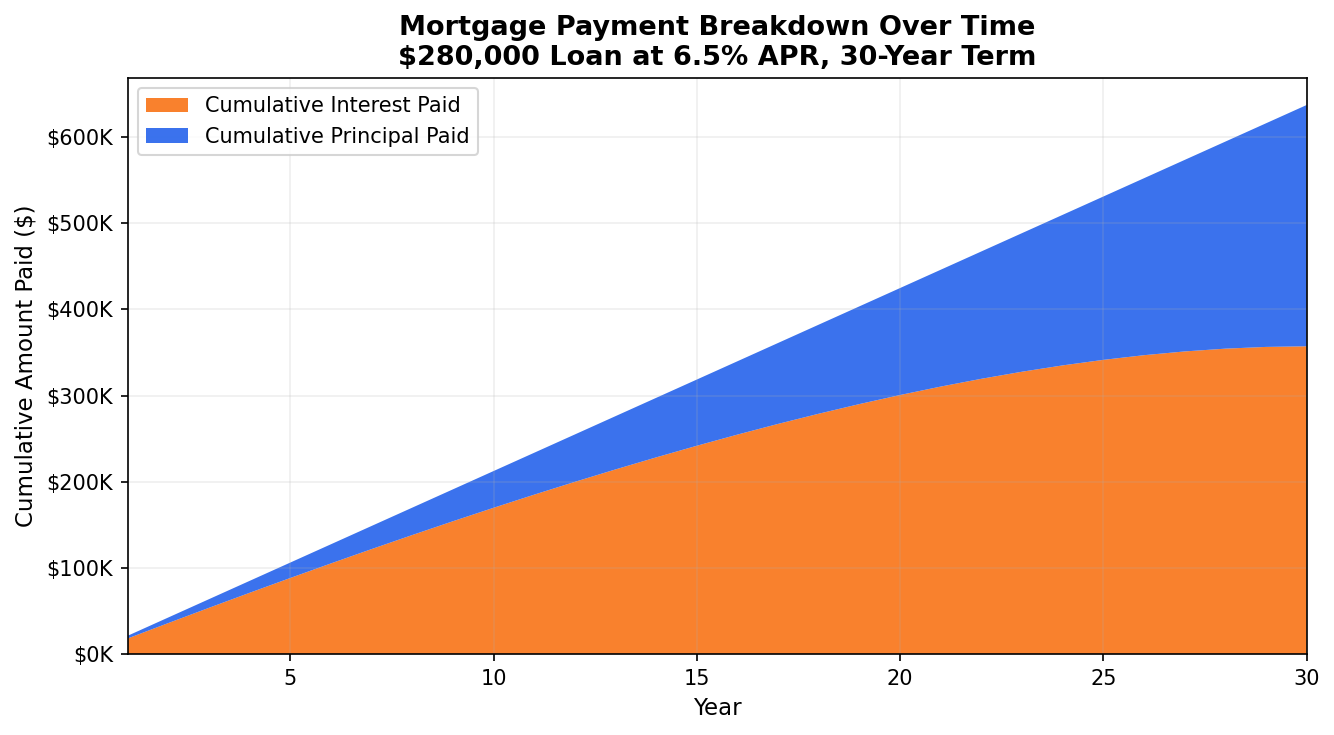
Internally, the tool allocates the loan amount across the monthly payments covering the entire loan term, calculating interest each month based on the outstanding principal balance. Early in the term, the majority of the payment goes toward interest, whereas later on, a larger proportion is applied to paying down the principal. For this reason, making an early principal repayment—even a modest one—during the first few years of the loan can significantly reduce its total duration.
How to interpret your mortgage calculator results
Monthly payment (principal and interest)
This is the key figure most users look for in a mortgage calculator: the actual amount you will pay each month to cover principal and interest, excluding taxes and insurance.
Private Mortgage Insurance (PMI)
If your down payment is less than 20% of the purchase price, lenders typically require private mortgage insurance (PMI) to protect against the risk of default. This calculator automatically estimates this additional monthly cost, where applicable. This allows you to see the relationship between a smaller down payment and a higher monthly payment later on.
Total interest paid
On a 30-year loan, the total interest paid can exceed the original loan amount. Knowing this figure before signing the contract is a major advantage of using a calculator; often, this amount is what leads buyers to consider a shorter loan term.
Fixed rate vs. variable rate: the importance of the interest rate entered
This calculator assumes a fixed rate applied over the entire term of the loan; this is the most common and predictable option. If you are comparing a fixed-rate loan with a variable-rate loan (ARM), keep in mind that the rate on the latter—and consequently your monthly payment—can change after an initial fixed-rate period (usually 5, 7, or 10 years). By using the calculator with the projected rate following the adjustment period, you can get a rough idea of what a future increase in your monthly payment might look like.
What this mortgage calculator doesn’t account for
While this calculator provides an accurate estimate of principal and interest repayments, your actual monthly housing-related expenses usually also include property taxes, homeowners insurance, and—if applicable—homeowners association (HOA) fees. Since these costs vary significantly by location, they are not factored into a standard mortgage calculator.
For more information on the components of a full monthly payment and the limitations of this type of tool, consult the Consumer Financial Protection Bureau (CFPB) guide on mortgage calculators.
Tips for effectively using a mortgage calculator
- Explore different scenarios: try out various down payment amounts to see how they affect your monthly payment and whether they allow you to avoid private mortgage insurance (PMI).
- Compare loan terms: a 15-year loan entails a higher monthly payment, but the total interest cost is significantly lower than that of a 30-year loan.
- Use a realistic interest rate: look up current average rates rather than making a rough guess, as a difference of just 0.5% can significantly alter your monthly payment.
- Consider your overall budget: once you have the estimated monthly payment, add a rough estimate for property taxes and insurance to better understand your actual monthly expenses.
- Recheck the figures if rates change: interest rates fluctuate regularly; therefore, it is useful to run the calculation again if you plan to buy a home in the coming months.
Who is this mortgage calculator for?
This calculator is useful at almost every stage of the home-buying process. First-time homebuyers can get a realistic idea of the price range that fits their budget before they even start looking. Homeowners considering a move can compare their current rate with a new offer. Finally, those undecided between a 15-year and a 30-year loan term can directly compare the differences in actual cost, rather than settling for estimates.
If you’re comparing loan options for other types of financing, our Home Loan EMI Calculator can help with India-specific mortgage calculations.
Frequently Asked Questions
Q: How accurate is this mortgage calculator?
A: This calculator uses the same formula for principal and interest amortization that lenders use; therefore, this part of the calculation is accurate. It does not account for property taxes, insurance premiums, or homeowners association (HOA) fees, as these elements vary by location and are not part of a standard mortgage calculation.
Q: How large a down payment is needed to avoid Private Mortgage Insurance (PMI)?
A: Generally, you can avoid Private Mortgage Insurance (PMI) if your down payment is at least 20% of the purchase price. If the down payment is below this threshold, the calculator computes the additional cost associated with PMI.
Q: Do I save more money with a 15-year loan or a 30-year loan?
A: With a 15-year term, the monthly payment is higher, but the total interest paid over the life of the loan is significantly lower. Compare both terms directly using this calculator.
Q: Can I use this calculator for refinancing (renegotiating the loan)?
A: Yes. Instead of the purchase price, enter the outstanding loan balance, set the down payment to zero, and use the new interest rate and desired term to determine the new monthly payment amount.
Q: Why does my lender’s estimate differ slightly from this calculator’s result?
A: Lenders consider your individual credit profile, the loan type, and any potential “points” (interest rate reduction points) or fees included in the loan; these factors can slightly alter the interest rate and monthly payment. This mortgage calculator provides a reliable general estimate; however, to obtain an accurate calculation, you should base it on your lender’s official Loan Estimate.